



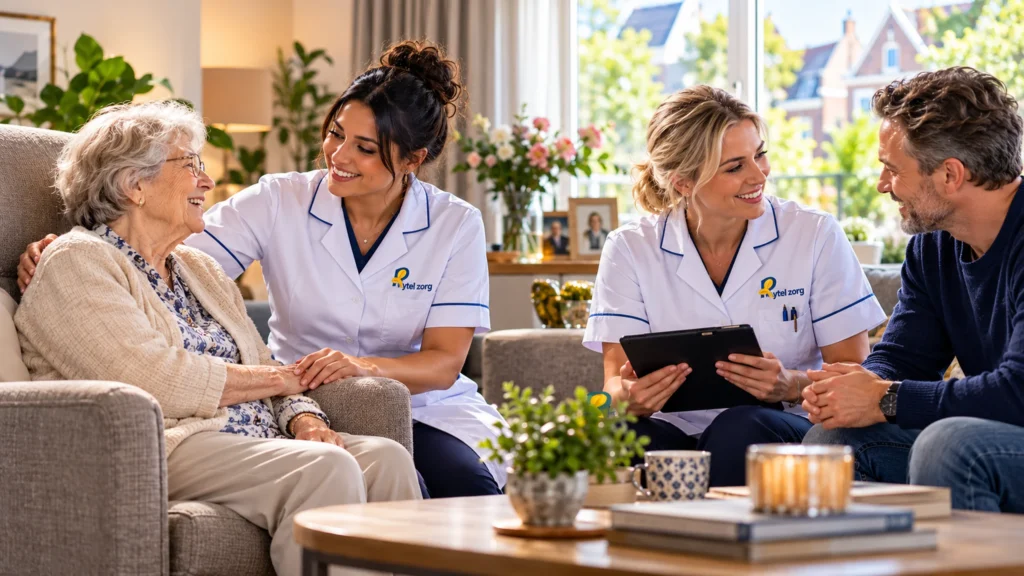


Anyone who needs care in the Netherlands, or arranges care for someone else, soon comes across abbreviations such as Wlz, Wmo, Zvw, Jeugdwet and pgb. Each scheme has its own conditions, its own counter and its own body that decides. As a result, many people do not know what they are entitled to. That is why RytelZorg developed the Zorgcheck: a digital orientation tool that clearly shows which care route may fit a situation and who decides on it.
Why we developed the Zorgcheck
The Zorgcheck started with one goal: helping people who do not know what they are entitled to and get stuck in rules, counters and forms. We believe everyone has the right to clear information about care, without barriers. That is why the Zorgcheck is without obligation, anonymous and available to everyone who lives in the Netherlands.
We then developed the Zorgcheck further for professionals in health and social care. This way, GPs, carers, nurses, municipalities and hospitals can also guide their clients and patients in a more targeted way.
The care routes in the Netherlands at a glance
Below you can see in brief which schemes exist, what they are for and which body decides.
| Scheme | For whom and for what | Who decides |
|---|---|---|
| Wlz (Long-term Care Act) | People who permanently need constant supervision or 24-hour care nearby, at home or in an institution. | The CIZ assesses the eligibility; the care office (zorgkantoor) arranges the care. |
| Wmo 2015 (Social Support Act) | Support to keep living independently at home for as long as possible, for example guidance, aids or a home adaptation. | The municipality. |
| Zvw (Health Insurance Act) | Medical care and district nursing (wijkverpleging): nursing and personal care in your home. | The health insurer. For district nursing, a district nurse (wijkverpleegkundige) determines which care is needed. |
| Jeugdwet (Youth Act) | Help and support for children and young people up to the age of 18 and their parents. | The municipality. |
| pgb (personal budget) | Not a separate law, but a way to receive care under the Wlz, Wmo, Zvw or Jeugdwet: you choose and arrange the care yourself. | The body responsible under the relevant law grants the pgb; the SVB pays the care providers. |
Unsure about a term? Our home care glossary explains the key terms in plain language.
How the Zorgcheck works
- Choose who the check is for: yourself, a loved one, your child or, as a professional, a client from your work.
- Answer simple questions at your own pace. As a professional, you answer the questions from your client’s situation.
- View the outcome: you immediately see which route may fit (Wlz, Wmo, Zvw, Jeugdwet or pgb) and which body decides.
- Would you rather not continue alone? Then RytelZorg discusses the next steps with you.
The Zorgcheck is available in Dutch, English, French and Arabic, and works on computers, tablets and smartphones.
For clients, families and informal carers
Do you notice that things at home are no longer going as they used to, for yourself or for your father, mother or partner? Then the first question is often: where do I start? The Zorgcheck gives you a first direction:
- you see which scheme you can have assessed;
- you know which body you can turn to;
- you go into the conversation with the municipality, the health insurer, the CIZ or your GP well prepared.
Would you rather not continue alone afterwards? RytelZorg offers a no-obligation 30-minute introductory meeting at your home. Together we look at your situation and the possible next steps.
For professionals in health and social care
Professionals receive questions about care and funding every day. The Zorgcheck helps to answer those questions in a structured and transparent way. In the Zorgcheck, choose the option for professionals: the questions will then be about your client.
GP and practice nurse
- Do the check together with your patient and email the outcome to them.
- Your patient knows which scheme they can have assessed and by which body.
- Less research for you, during or after the consultation.
Certified carer (Verzorgende IG, level 3) and nurse (level 4)
- Is the care need at home changing? Then you see which route may fit.
- You hold a well-founded conversation with the client, the family and the district nurse.
- You notice earlier when another scheme, such as the Wlz, may come into view.
District nurse
- A clear starting point for a new care need or for the transition from the Zvw to the Wlz.
- The Zorgcheck does not replace your needs assessment (indicatiestelling), but helps you prepare the conversation with the client and the family.
Municipality, Wmo consultant and neighbourhood team
- You see whether a question belongs to the Wmo or rather to the Zvw, the Wlz or the Jeugdwet.
- This way, the resident ends up at the right counter.
Hospital, transfer nurse and social work
- One clear starting point at discharge, handover or a new request for help.
- After the check, the client and the family know which body they can approach.
Privacy and legislation: patient and client data protected
The Zorgcheck was developed in line with the General Data Protection Regulation (GDPR, in Dutch: AVG) and Dutch care legislation, with privacy by design as the starting point.
- Free, anonymous and without an account.
- Your answers stay with you: while you fill in the check, they remain encrypted in your own browser. Nothing is sent to RytelZorg.
- Saving is optional: only on your own device, protected with a code you choose yourself. After 90 days without use, the data is deleted.
- Only with your consent: only those who ask for help themselves and give explicit consent share data with RytelZorg.
- No automated decisions: every outcome is an indication and every assessment is made by people.
Guidance, not a decision
The outcome of the Zorgcheck is indicative. The Zorgcheck makes no diagnosis and takes no decisions: only the competent bodies decide, such as the CIZ, the care office, the municipality and the health insurer. We regularly update the Zorgcheck based on official government sources. Do you have a medical question? Contact your GP. In case of immediate danger, call 112.
Frequently asked questions about the Zorgcheck
Does the Zorgcheck cost anything?
No. The Zorgcheck is without obligation: there are no costs and no commitments.
Do I need to create an account?
No. You do not need an account and you remain anonymous.
What happens to my answers?
While you fill in the check, your answers remain encrypted in your own browser. Nothing is sent to RytelZorg, unless you ask for help yourself and give your consent.
Is the outcome an official decision?
No. The outcome is guidance based on your own answers. Only the competent body takes a decision.
Can I use the Zorgcheck as a professional?
Yes. Choose the option for professionals: the questions will then be about your client. You can do the check together with your client or patient and email the outcome to them.
In which languages is the Zorgcheck available?
In Dutch, English, French and Arabic.
Who is the Zorgcheck for?
For everyone who lives in the Netherlands: clients, families, informal carers and professionals.
What if I want help with the next steps?
Then RytelZorg discusses the next steps with you. You can also choose a no-obligation 30-minute introductory meeting at your home.
The Zorgcheck in a short video
Take the Zorgcheck now
Would you like to know which care route may fit your situation or that of your client? Start the Zorgcheck. Do you have questions or would you like to work together? Email info@rytelzorg.nl or call 070 211 2261. We are available 24/7.